
The Ultimate 2026 Guide to Choosing an Offshore RCM Partner

How to Evaluate, Select, and Scale a Revenue Cycle Management Partner
Outsourcing Revenue Cycle Management (RCM) has become a strategic lever for US healthcare organizations looking to optimize cost, improve collections, and overcome staff shortages. But with dozens of offshore vendors emerging from regions like Sri Lanka, India, and the Philippines, how do you know who to trust with your financial lifeline?
This guide walks you through every stage of selecting the right offshore RCM partner—from defining your goals to evaluating HIPAA compliance, running pilot projects, managing transition risk, and measuring ROI.
You’ll find:
Why offshore RCM is trending in 2026
Key benefits and risks
Step-by-step vendor evaluation checklist
Security, compliance, and HIPAA essentials
Pricing model comparison (flat-fee vs % of collections)
Pilot project roadmap
Governance and KPI tracking
Common pitfalls (and how to avoid them)
Templates and questions to ask your next RCM partner
Why Offshore RCM Is Growing Rapidly in 2026
In the US, the RCM industry faces a perfect storm:
Ongoing billing staff shortages
Rising administrative costs (often >$0.10 per claim line)
Increasing payer complexity and denials
Pressure to reduce Days in AR and maintain <10% denial rates
Expanding regulatory overhead (HIPAA, CMS, state compliance)
Offshore RCM solutions, particularly from Sri Lanka, have matured—offering:
Certified coders (AAPC/AHIMA-trained)
HIPAA-compliant infrastructure
US timezone alignment (via split shifts)
Significant cost savings (often 50–70%)
Bilingual EN/ES patient support
In 2026, smart outsourcing isn’t about cost alone—it’s about resilience, compliance, and visibility.
Benefits of Outsourcing RCM Offshore
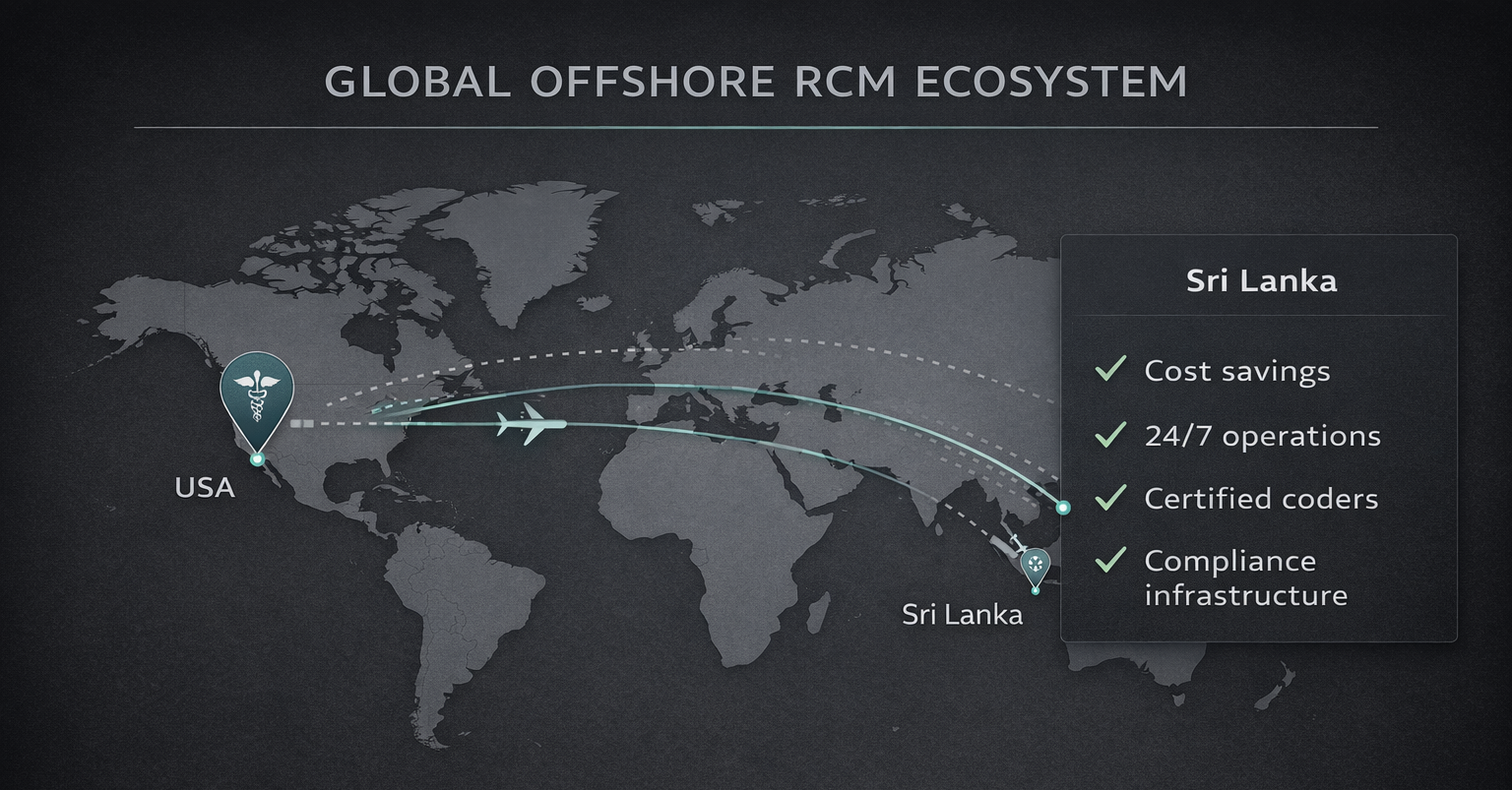
Cost Efficiency
Offshore teams cost a fraction of equivalent US salaries. Savings can be reinvested into care quality or technology.
Scalability
Ramp up or down based on seasonality or payer volumes without US hiring delays.
Access to Specialized Talent
Sri Lanka, India, and other markets offer deep RCM talent pools trained for US payers and ICD-10/CPT.
Focus on Core Healthcare Delivery
Clinics spend less time chasing claims and more on patient outcomes.
Round-the-Clock Operations
Time-zone differences enable near 24/7 throughput—claims move while the US sleeps.
Risks (and How to Mitigate Them)
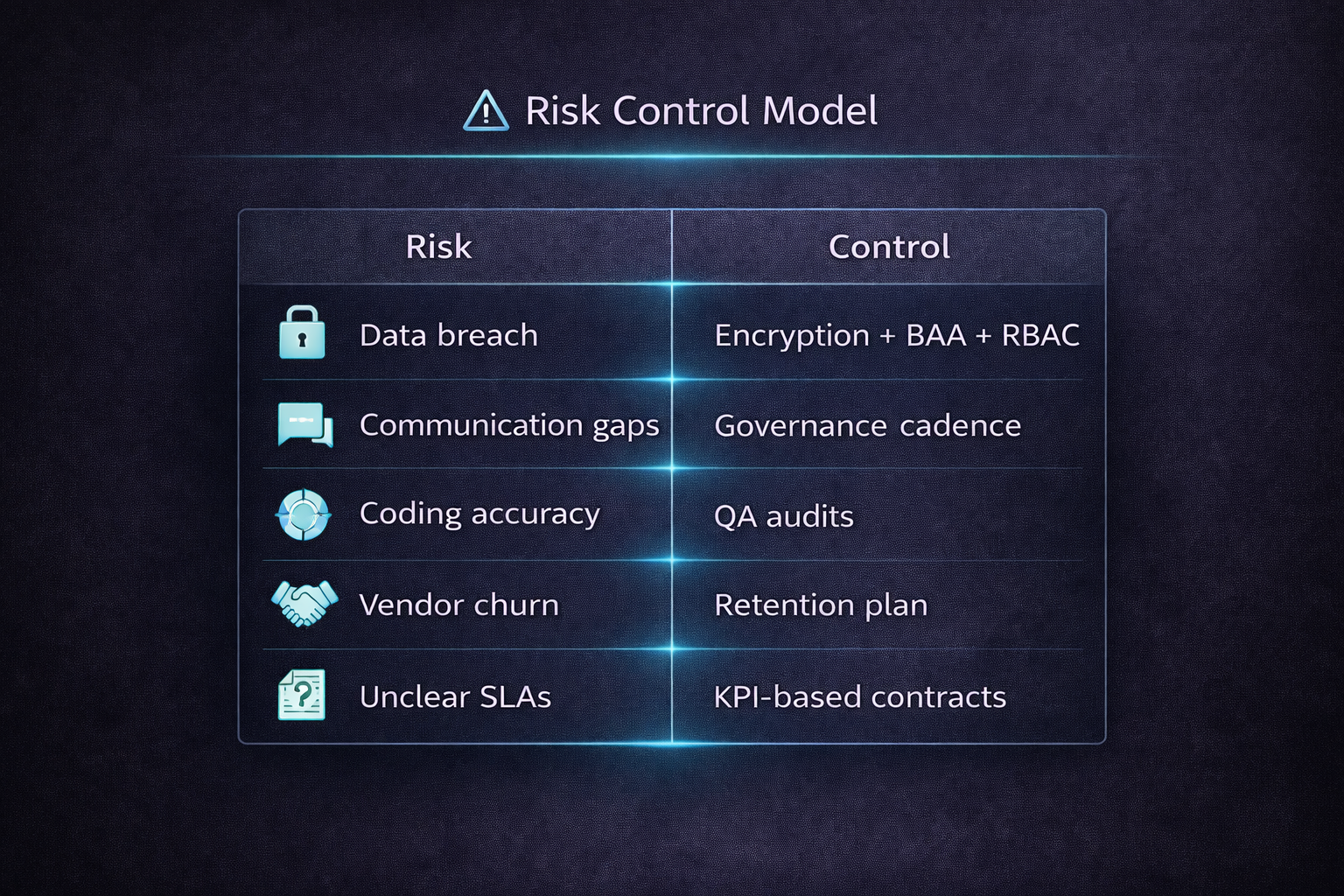
Potential RiskImpactMitigation StrategyData security breachHIPAA violation, reputational lossBAA, encryption at rest/in transit, RBAC, audit trailsPoor communicationDelays, misalignmentWeekly governance, defined escalation, US overlap hoursLow coding accuracyDenials, lost revenueCertified coders, QA sampling, accuracy KPIsUnclear SLAsUnmet expectationsMeasurable KPIs, incentives/penaltiesVendor churnDisrupted operationsCheck turnover rates, retention plans, backup staffing.
A well-managed partnership uses documented workflows, SLAs, and regular KPI reviews to keep risks controlled.
Step-by-Step Process to Choose the Right Offshore RCM Partner
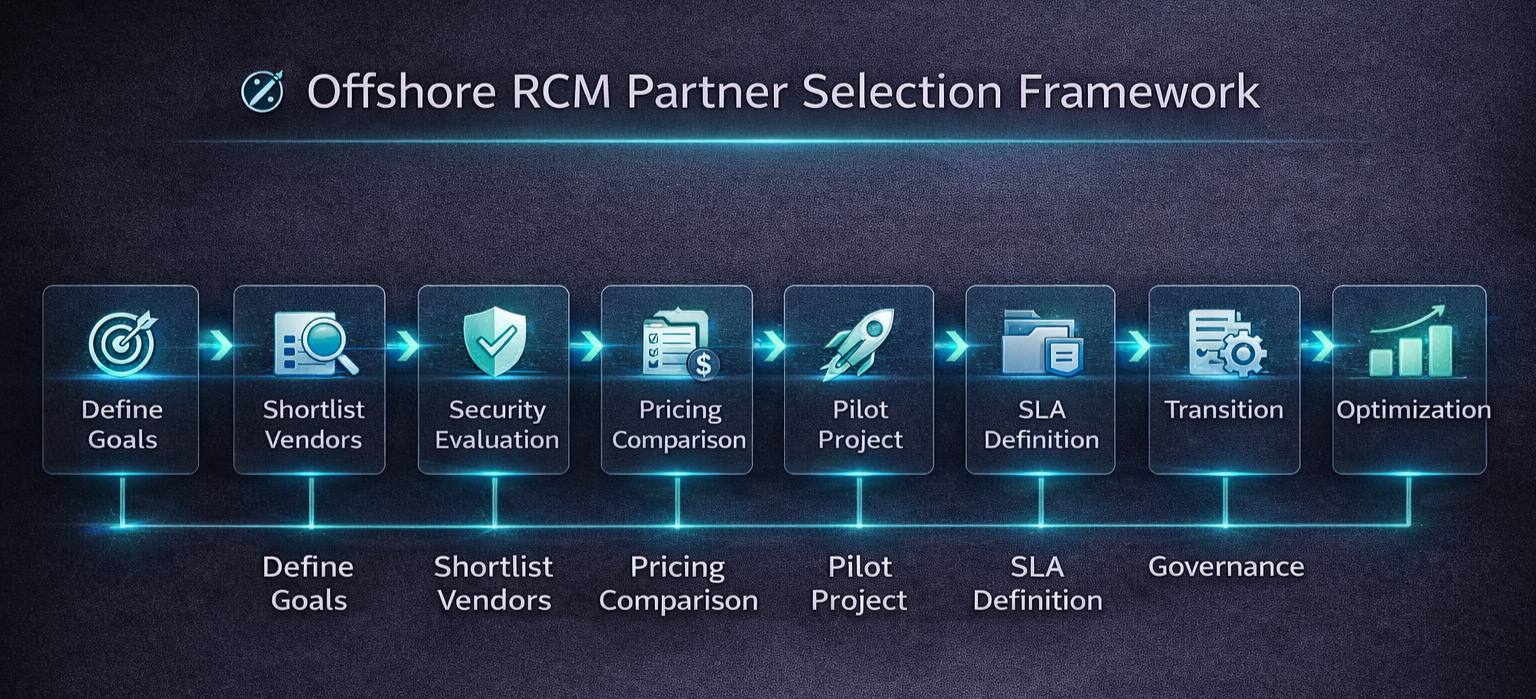
Step 1 — Define Your Goals and Scope
Clarify:
Pain points (denials, AR aging, staffing gaps)
Scope (end-to-end RCM vs partial functions)
Targets (Days in AR <30, Denial Rate <8%)
Must-haves (credentialing, analytics, patient collections)
Example:
“We will outsource coding, billing, and AR follow-up for 5 providers, aiming to cut AR from 45 to <30 days in 6 months.”
Step 2 — Shortlist Qualified Vendors
Look for:
Proven US healthcare client base
Certified coding teams
HIPAA documentation
Positive third-party reviews
Transparent pricing
Example shortlist (2026):
Impact Innovations (Sri Lanka)
Medigain Colombo
Omega Healthcare (India)
GeBBS Healthcare Solutions (India)
Access Healthcare (Philippines)
(Even large players now partner with niche teams like Impact Innovations for specialized workflows.)
Step 3 — Evaluate Compliance and Data Security
Non-negotiables:
Signed BAA
SOC 2 / ISO 27001 (if available)
Encryption (at rest/in transit)
MFA, RBAC, VPN/VDI
Documented incident response
Ask:
“Where is data stored and who can access it?”
“How often do you run penetration tests?”
“Do you have an internal HIPAA officer?”
Step 4 — Compare Pricing Models
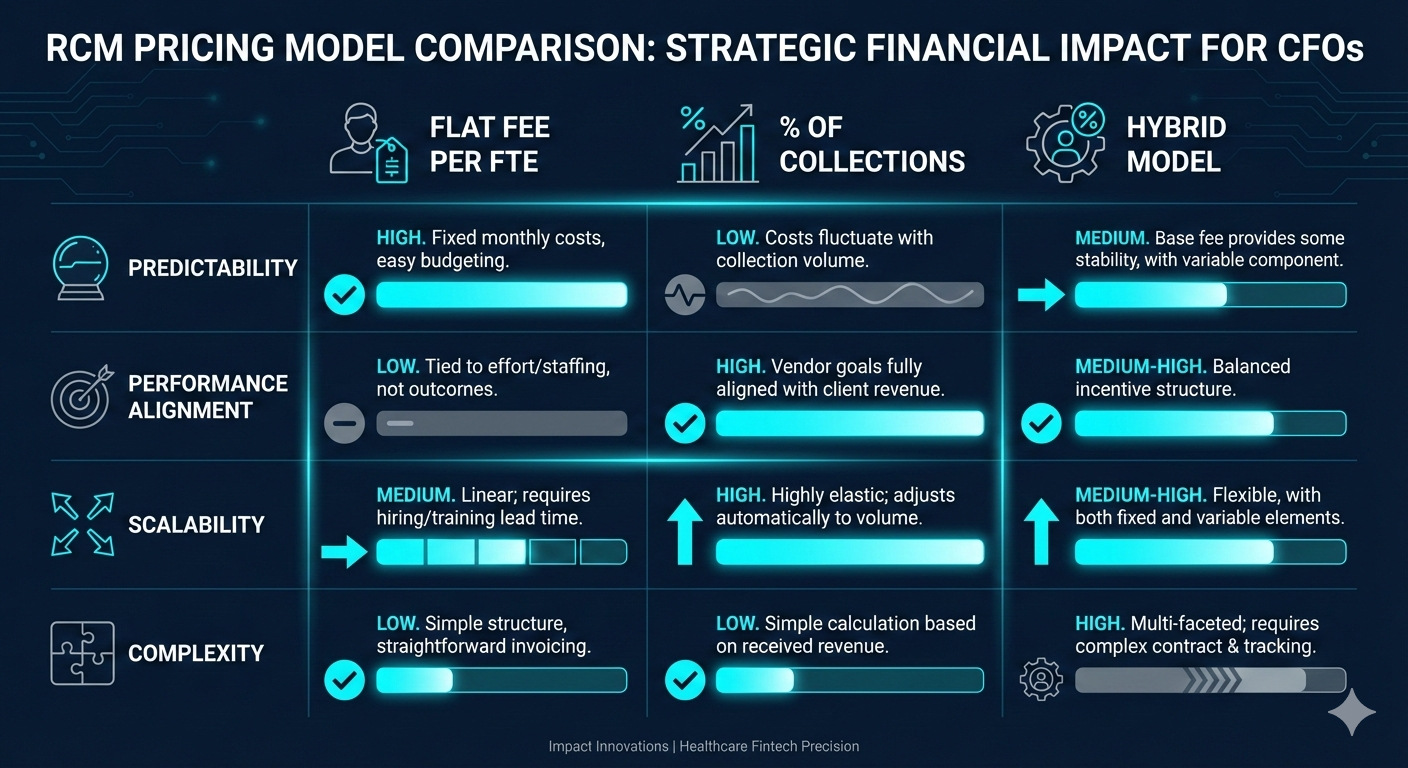
ModelBest ForAdvantagesDisadvantagesFlat-Fee per FTEPredictable volumesEasy budgetingWeaker performance alignment% of CollectionsVariable volumesIncentives alignedHarder to benchmark w/ mix changesHybridLarger practicesPredictability + accountabilityMore complex to manage
Pro tip: Request a transparent breakdown (labor, tech, overhead, management). Avoid “black box” pricing.
Step 5 — Assess Service Capability and Tech Infrastructure
Prioritize vendors that offer:
End-to-end RCM: registration → coding → billing → denials → AR → patient collections
Tech integration: Athenahealth, Kareo, NextGen, eClinicalWorks, etc.
Analytics dashboards: CFO-ready KPI tracking (Days in AR, denials, net collections)
Automation: RPA for claim status/payment posting
Bilingual patient comms (EN/ES)
Dedicated account manager
Step 6 — Run a Pilot Project (60–90 Days)
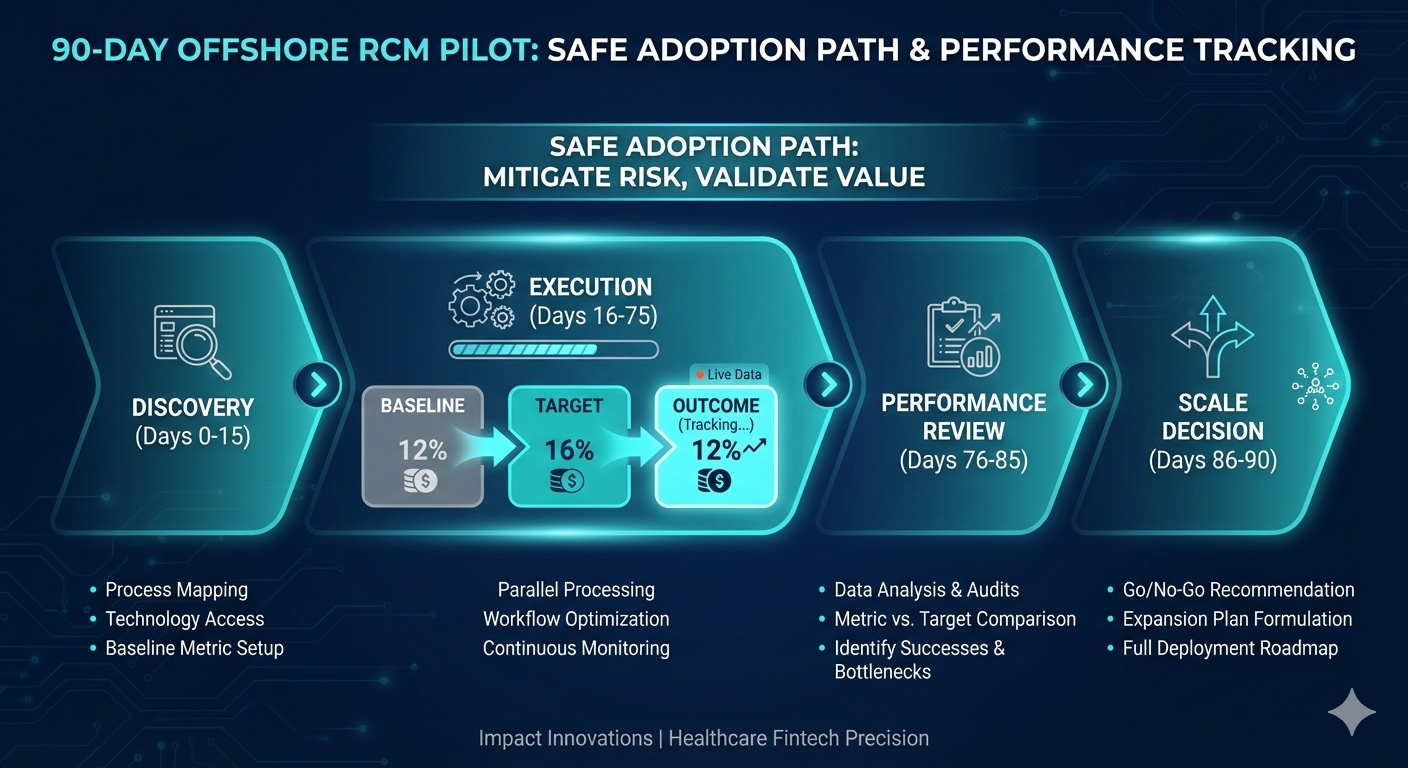
Goals:
Baseline KPIs → Targets (e.g., Days in AR ↓ 25%) → Data flow → Turnaround → Comms → Cultural fit
Example Pilot Structure
Discovery => Week 1–2: Process mapping, access, data migration
Execution => Week 3–8: Live claims, posting, denial handling
Review => Week 9–12: KPI results, lessons, scale plan
Scale only if metrics improve and communication is seamless.
Step 7 — Define SLAs (Service Level Agreements)
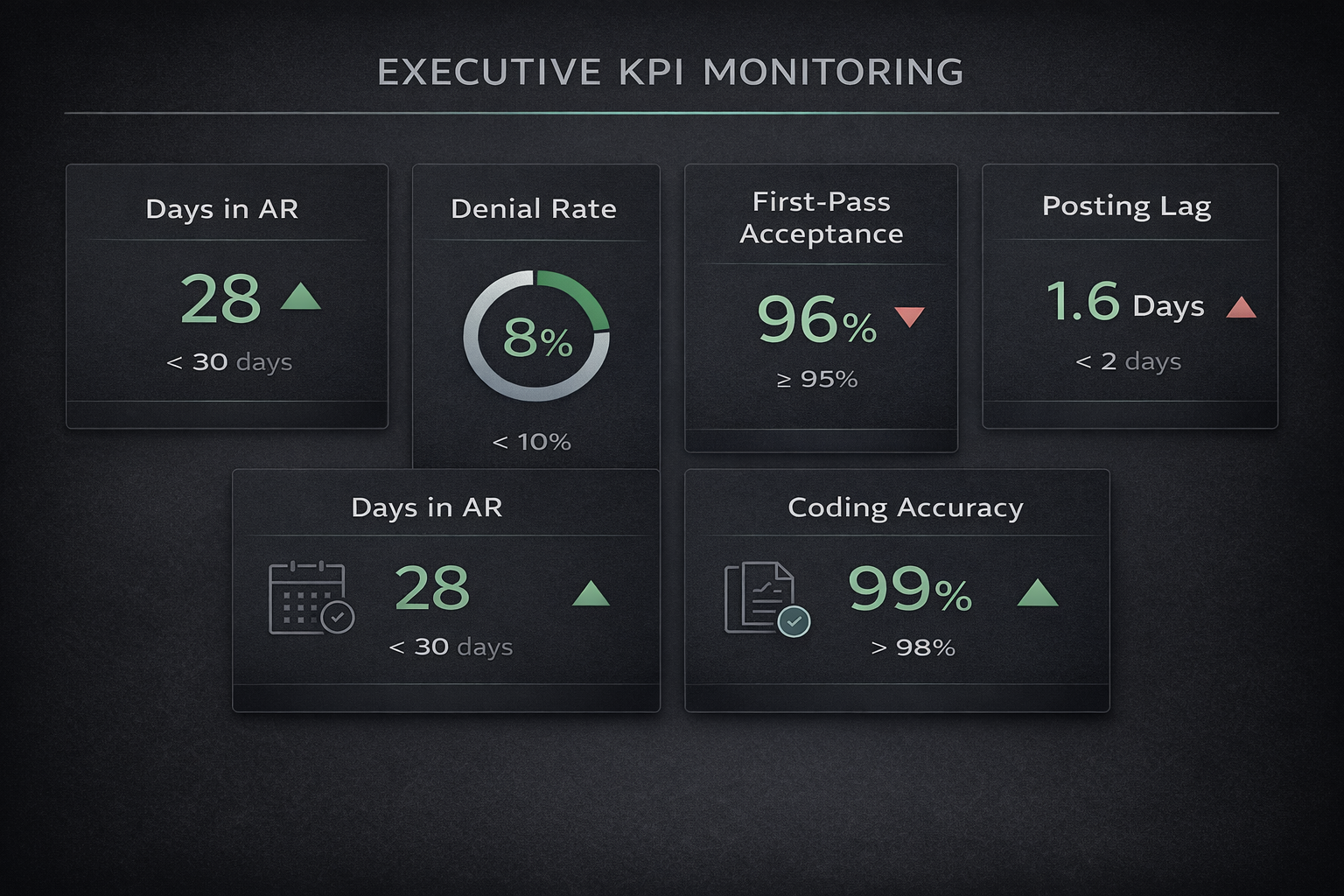
MetricTarget SLANotesDays in AR<30Average across payersDenial Rate<8%Excluding re-billsFirst-Pass Acceptance>95%Clean claim submissionPayment Posting Lag<48 hoursFrom ERA receiptAR Over 90 Days<5%Monitored monthlyCoding Accuracy>95%Random audit sampleResponse Time<24 hoursTicket/issue acknowledgement
Tie incentives or penalties to SLA performance.
Step 8 — Migration and Transition Plan
Document front-, mid-, back-end workflows
Map EHR, clearinghouse, bank remittances
Define user access and data permissions
Train vendor on internal SOPs
Parallel processing for 1–2 billing cycles
Go live once KPIs stabilize
Best practice: Keep one internal US RCM lead coordinating during the first 3 months.
Step 9 — Governance and Communication Framework
Daily huddles: task status
Weekly ops reviews: AR, denials, posting lag
Monthly executive review: KPI dashboard, actions
QBR: SLA, staffing, roadmap
Use Teams/Slack/Asana for live tracking. Maintain a single shared KPI dashboard.
Step 10 — Monitor KPIs and Optimize Continuously
Track from day one:
Days in AR (<30)
Denial Rate (<8%)
First-Pass Rate (>95%)
Net Collection Rate (>95%)
AR >90 (<5%)
Charge Capture Accuracy (>98%)
Coding Compliance (>95%)
Monthly CFO reports should include trendlines, payer performance, denial root causes, and recommended fixes.
Vendors like Impact Innovations provide exportable KPI dashboards and CFO-ready summaries—a major differentiator vs generic BPOs.
Red Flags to Avoid When Selecting a Vendor
No signed HIPAA BAA
Hidden costs / unclear pricing
No metrics or SLA guarantees
Poor communication / limited US overlap
Limited US payer experience
Heavy reliance on manual processes, no automation
Staff churn >20% annually
No disaster recovery or backup plan
Credible partners welcome transparency, audits, and KPI tracking.
Example: Successful Offshore RCM Transition (Case Study)
Background:
A 12-provider orthopedic group in Florida faced mounting denials, inconsistent coding, and staff attrition. They outsourced end-to-end RCM to a Sri Lanka–based vendor (Impact Innovations).
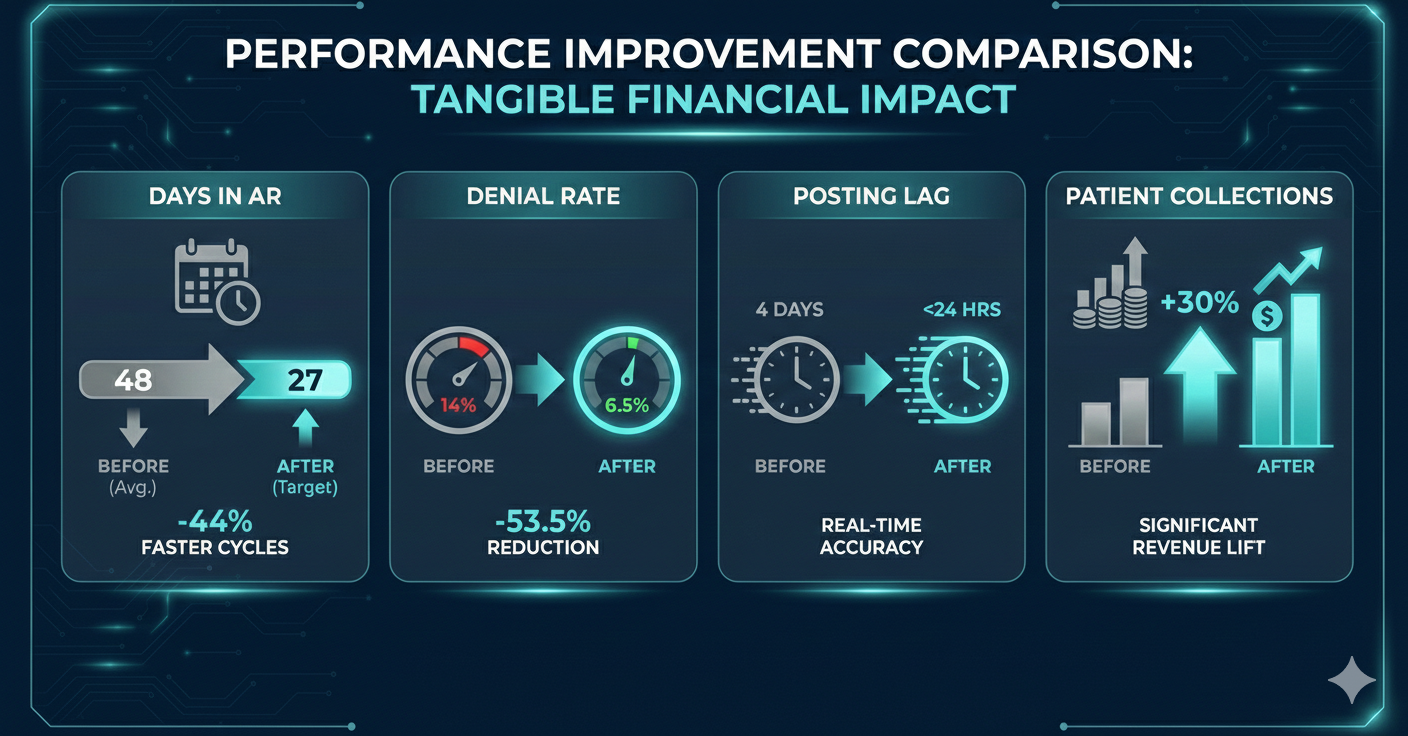
Initial metrics:
Days in AR: 48
Denial Rate: 14%
Payment posting lag: 4 days
After 6 months:
Days in AR: 27
Denial Rate: 6.5%
Posting lag: <24 hours
Patient collections: +30% via digital portals
Total cost reduction: 45% vs in-house
Success drivers:
US-overlap account manager • AAPC-certified coders • KPI dashboards • Bi-weekly SLA reviews
Technology Stack to Ask About
CategoryExamplesPractice ManagementAthenahealth, NextGen, eClinicalWorks, KareoClearinghouseAvaility, Change Healthcare, Office AllyDenial ManagementWaystar, CollaborateMDAnalytics DashboardsPower BI, Tableau, LookerAutomation ToolsUiPath, Automation AnywhereCommunicationTeams, Zoom, SlackSecurityMFA, VPN, SOC 2–certified data centers
Ask for live demos or anonymized client reports.
Pricing Transparency Checklist
Request:
Line-item costs (FTE, tech, management)
Exchange-rate assumptions (for offshore)
SLA-based incentives/penalties
Renewal/termination clauses
Invoicing currency (USD recommended)
Any “change management” or hidden fees
Sample RFP (Request for Proposal) Questions
How many US healthcare clients do you serve?
Do you handle Medicare, Medicaid, and commercial payers?
Typical improvement in Days in AR and Denial Rate after onboarding?
Are staff AAPC/AHIMA-certified?
What’s your security framework (encryption, SOC 2, ISO)?
How do you ensure HIPAA compliance?
Which EHRs/PMs are you integrated with?
Can you share example KPI dashboards?
How do you train and retain staff? Turnover rate?
What are escalation procedures for claim backlogs?
Continuous Improvement and Innovation
An RCM partnership should evolve—not stagnate. Top vendors invest in:
AI-driven denial prediction
RPA for claim status and posting
Advanced analytics for payer trend forecasting
CDI (Clinical Documentation Improvement) programs
Regular coder upskilling (CPT/ICD-10 updates)
The best partners bring ideas proactively—not just execute tasks.
Offshore Destination Comparison (2026 Snapshot)
CountryKey StrengthsPotential DrawbacksSri LankaSkilled workforce, English fluency, cost-effective, low attrition, cultural alignmentSmaller scale vs IndiaIndiaHuge talent pool, mature infrastructureHigher cost, higher turnoverPhilippinesStrong English, empathetic supportLimited coding/cert expertisePakistanCompetitive pricing, emerging talentVariable compliance maturity
For US healthcare, Sri Lanka offers a strong balance of quality, compliance, and cost—especially via RCM-specialized firms like Impact Innovations.
Summary — The Ideal Offshore RCM Partner Checklist
Proven US RCM experience
HIPAA-compliant infrastructure
Certified coders and billing experts
Secure data hosting (US or compliant offshore)
Clear SLAs and KPI dashboards
Transparent, flexible pricing
Dedicated account management
Bilingual patient/payer support
Scalable operations
Culture of continuous innovation
FAQs — Offshore RCM Outsourcing (2026 Edition)
Q1. Is offshore RCM safe for HIPAA-covered entities?
Yes—if the vendor signs a BAA, encrypts PHI, enforces RBAC/MFA, and audits regularly.
Q2. How long does migration take?
Typical 6–10 weeks (discovery → pilot → go-live).
Q3. Should small practices outsource RCM?
Often yes. It’s typically more cost-effective than maintaining in-house teams.
Q4. Which countries are best for RCM outsourcing?
Sri Lanka, India, and the Philippines lead; Sri Lanka is emerging as the most balanced option in 2026.
Q5. What’s a fair pricing range?
Usually 3–8% of collections or $1,200–$1,800 per FTE/month, depending on scope and complexity.
Q6. How do I measure vendor success?
Track Days in AR, Denial Rate, First-Pass Acceptance, Net Collection Rate.
Q7. Can offshore vendors handle credentialing and enrollment?
Yes. Many—including Impact Innovations—manage full payer credentialing and re-enrollment.
Q8. Biggest mistake clinics make?
Choosing on price alone—ignoring compliance, data access, and measurable outcomes.
Final Thoughts — The Future of Offshore RCM
By 2026, RCM outsourcing is more than cost reduction: it’s data-driven scalability, global collaboration, and financial resilience in a complex US healthcare landscape.
If you’re evaluating partners, look for vendors like Impact Innovations, who combine:
Proven US healthcare billing expertise
A HIPAA-secure environment
Transparent dashboards & KPI guarantees
A team culture built on precision, accountability, and innovation
Choose right, and your RCM becomes a strategic financial engine—not a back-office cost center.
