
How Tailored Billing Increases Lab Revenue — and When Labs Should Outsource RCM

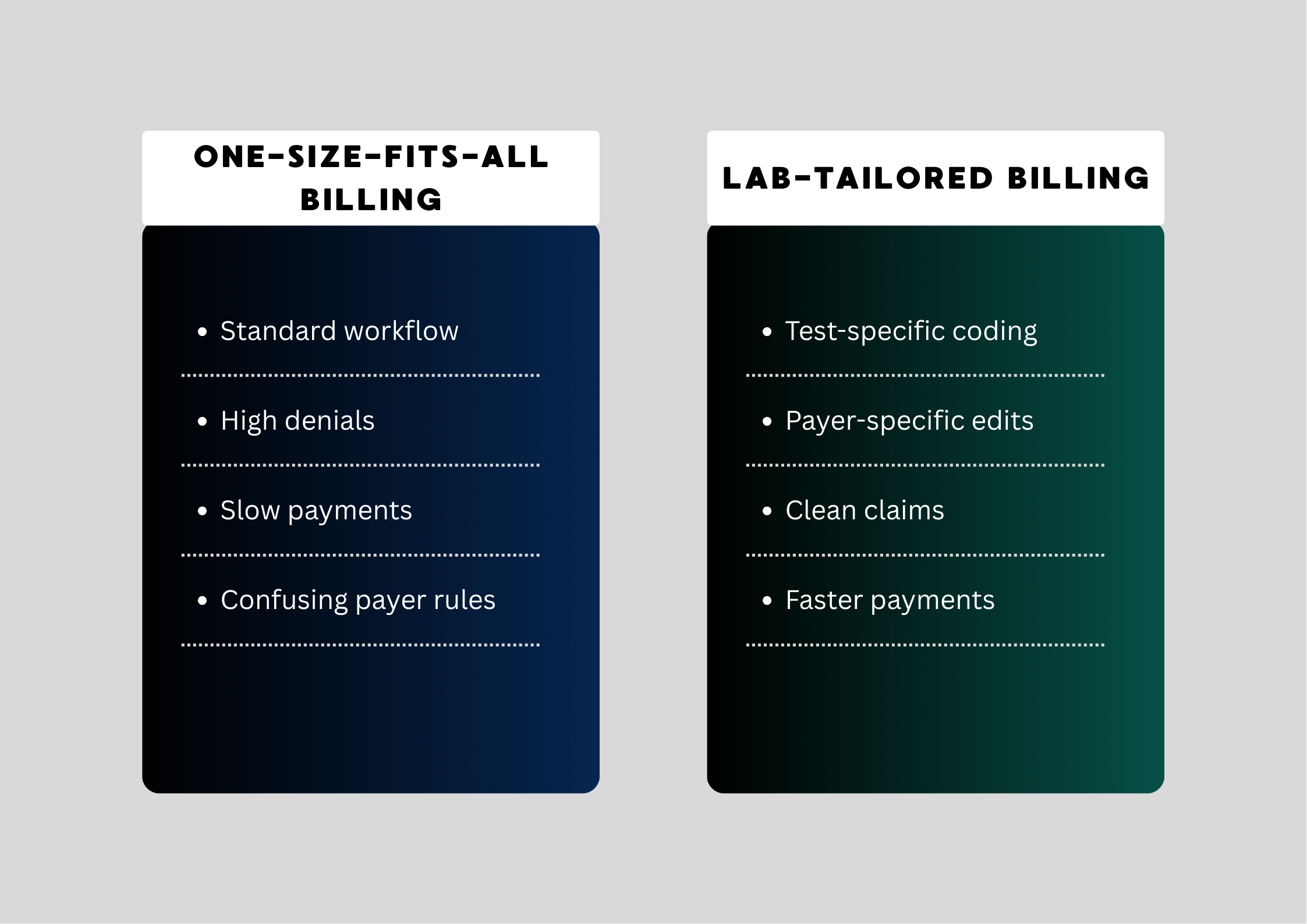
Clinical and diagnostic laboratories operate in one of the most challenging revenue environments in healthcare. Constant payer rule changes, strict coding requirements, high denial rates, and time-sensitive turnaround pressures make revenue cycle management (RCM) more than just an administrative function — it is the backbone of financial stability. Yet many labs still rely on generic, one-size-fits-all billing approaches that fail to reflect the unique nature of their test menu, operational workflow, payer mix, and clinical complexity.
That’s where tailored billing transforms financial performance. By aligning billing workflows and coding logic to the specific realities of each laboratory, labs unlock higher first-pass acceptance rates, fewer denials, faster cash flow, and more predictable revenue.
At the same time, many labs are grappling with staffing shortages, growing AR backlogs, and increasing payer scrutiny — making RCM outsourcing a strategic option. But not every lab should outsource, and not every RCM vendor is the right fit. Understanding when and why to outsource is as important as the process itself.
This article explores how personalized billing increases revenue, the pain points labs face today, and when outsourcing RCM becomes the financially and operationally sound choice.
Tailored Billing: What It Really Means for Laboratories
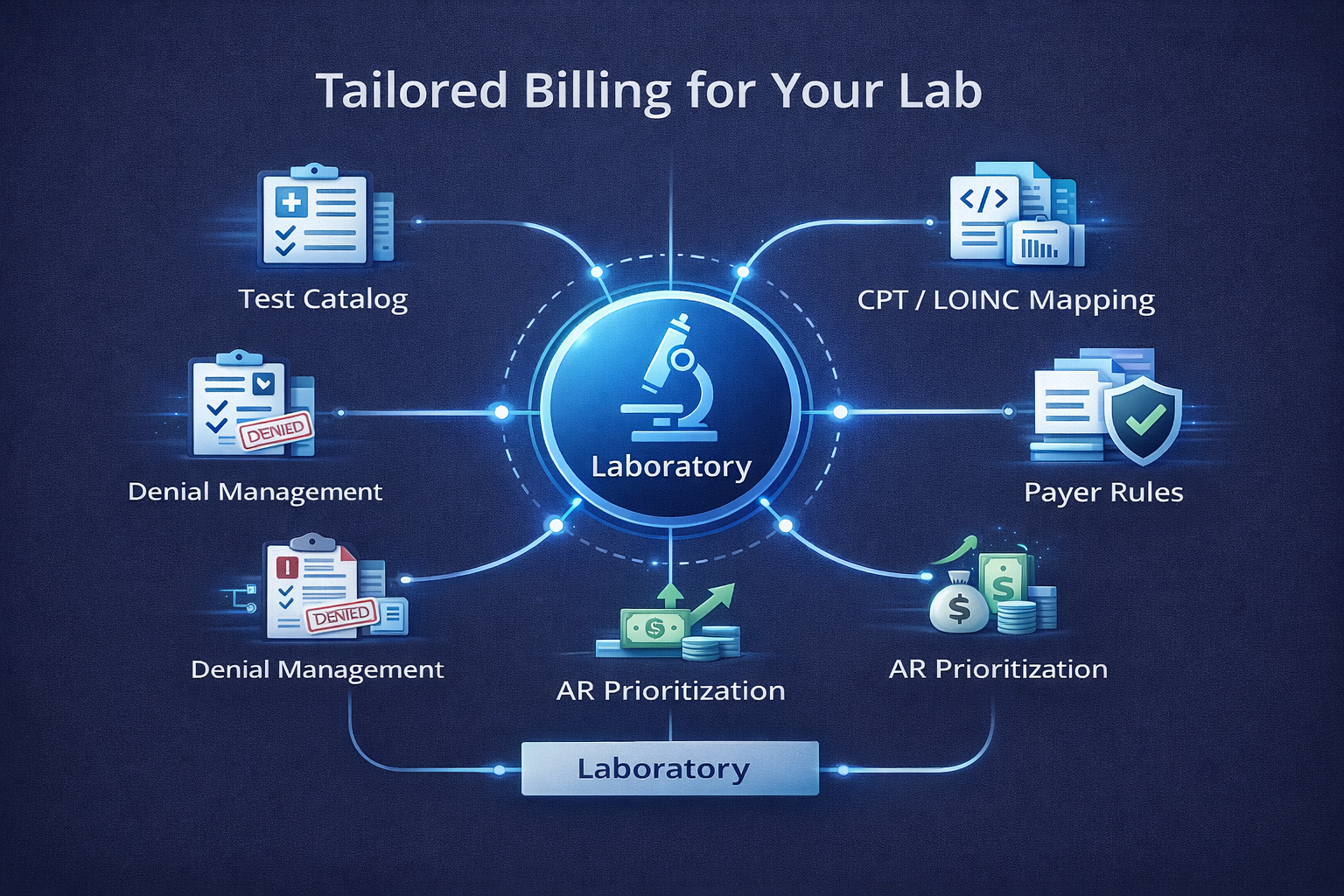
Tailored billing goes beyond basic claim submission. It is a fully customized revenue strategy designed around:
Your test catalog and CPT/LOINC mapping
Your payer mix and payer-specific rules
Your lab’s LIS/EHR setup and data flow
Your clinical workflow (panels, reflex tests, add-ons, molecular diagnostics, pathology, etc.)
Your highest-value revenue risks (e.g., underpayments, bundling issues, authorization requirements)
Instead of forcing every lab into the same billing template, tailored billing applies logic that fits the actual way the lab functions.
It includes:
Customized Payer Edits and Validation
Different payers have different bundling rules, authorization needs, clinical guidelines, and documentation requirements. Tailored billing configures claim edits specifically for those rules — preventing denials before the claim is even submitted.
Test-Level Coding Accuracy
Panels, molecular diagnostics, genetics, microbiology, and pathology each have coding nuances. Tailored billing creates a code map that captures:
Correct CPT and HCPCS codes
Required modifiers
Proper units
Specimen source detail
Reflex and add-on test logic
This ensures the claim reflects the exact test performed, reducing rejections and maximizing reimbursement accuracy.
Workflow-Aligned Billing Cycles
Some labs batch tests daily, others run high-volume panels weekly, and others operate 24/7 with on-call services. Tailored billing matches billing cadence to the actual lab output, ensuring claims flow smoothly and cash flow remains predictable.
AR Prioritization Unique to the Lab
A tailored AR strategy does not treat every claim equally. Instead, it focuses on:
High-dollar claims
Payers with historically inconsistent payments
Denials with the highest recovery probability
Contract discrepancies and underpayments
This structured prioritization is one of the strongest revenue lifts available.
Customized Denial Playbooks
Each payer denies claims differently — and each denial reason needs a precise, evidence-based response. Tailored billing builds payer-specific appeal templates and documentation packets to shorten resolution time.
The result is a billing system built around the lab, not the other way around.
How Tailored Billing Increases Lab Revenue
The financial impact of tailored billing is both measurable and significant. Here’s how personalization translates directly to improved revenue:
1. Higher First-Pass Acceptance
Before a claim goes out the door, payer-specific rules identify errors, missing data, or incompatible coding. This drastically reduces rejections and speeds payment.
Even a 5–10% lift in first-pass acceptance can add substantial monthly revenue for diagnostics labs, particularly high-volume molecular or pathology providers.
2. Lower Denial Rates and Appeal Costs
Every denial costs time, labor, and often money. Labs with generic billing systems experience repeated denials for the same issues. Tailored denial workflows prevent repeat denials and streamline appeals.
3. More Accurate Reimbursement and Contract Compliance
Payers frequently underpay — often unintentionally — due to outdated fee schedules, incorrect code adjudication, or bundling logic errors. Tailored billing includes contract-based reimbursement checks that identify and recover lost dollars.
4. Faster Cash Flow (Reduced Days in AR)
Tailored AR strategies focus on what matters:
High-value claims
Time-sensitive claims
Claims nearing timely-filing limits
High-risk payers
Labs that personalize their AR workflow typically see a 10–20% improvement in payment speed.
5. Lower Cost-to-Collect
By reducing errors, rework, and repeated submission cycles, tailored billing lowers administrative costs and improves overall efficiency.
6. Clearer Revenue Insights for Decision Making
Tailored billing creates better performance visibility. Labs can identify:
Which payers are most profitable
Which tests generate revenue leakage
Where operational bottlenecks occur
When to renegotiate payer contracts
This data is invaluable for leadership and financial planning.
Common Revenue Problems Labs Face Today
Most labs searching for RCM support are experiencing one or more of the following issues:
High claim denial rates
Frequent coding errors (CPT, LOINC, modifiers)
Slow payment turnaround
Growing AR > 90 days
Underpayments and missed contract revenue
Poor LIS/EHR → billing system data integrity
Eligibility and authorization breakdowns
Rapidly changing payer rules
Insufficient visibility into revenue KPIs
Staffing shortages or lack of billing expertise
Compliance risks (HIPAA, CLIA, documentation failures)
These pain points not only reduce revenue but also add operational strain. Many labs attempt internal fixes but lack the resources, expertise, or technology to implement lasting change — which is why outsourcing becomes a strategic option.
RCM Outsourcing: When Should Labs Consider It?
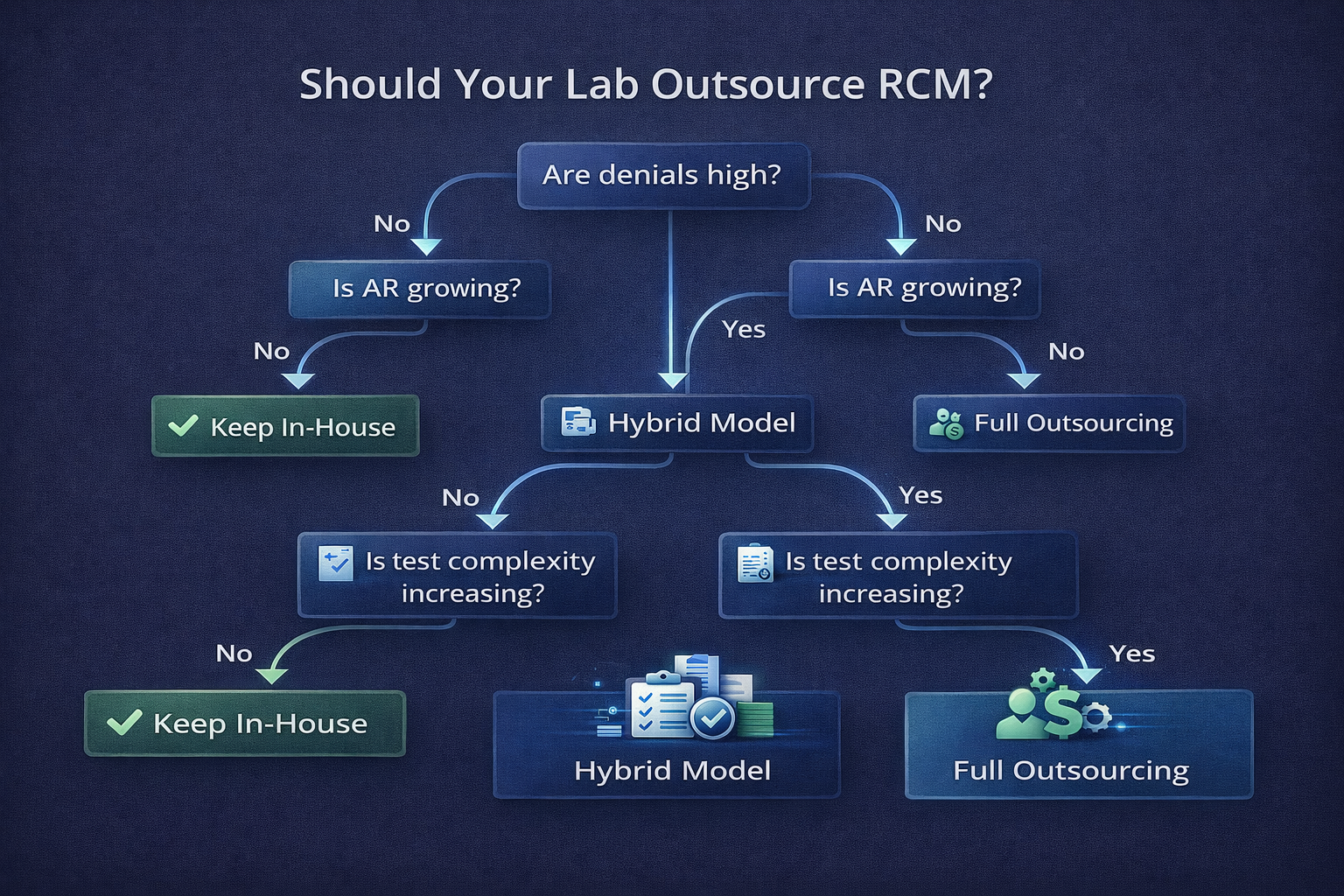
Outsourcing revenue cycle management is not a cost-cutting maneuver; it is a capability upgrade. Labs should consider outsourcing when any of the following situations arise:
1. Persistent High Denial Rates
If denials remain high after internal efforts to fix them, a specialized RCM partner can uncover root causes and deploy proven payer-specific strategies.
2. Staffing Challenges
Billing turnover is expensive and disruptive. Outsourcing gives labs access to trained analysts, coders, and collectors without the burden of hiring, training, and managing.
3. AR Backlogs and Cash Flow Problems
When a lab consistently struggles to maintain AR under control — especially AR > 90 days — outsourcing can rapidly stabilize cash flow.
4. Complex Test Menu or Multi-Site Operations
Molecular diagnostics, genetics, specialty pathology, and multi-state operations require advanced coding and payer expertise. Outsourced teams already have that infrastructure.
5. Need for Automation and Modern RCM Technology
Most labs lack the resources to deploy:
Rules engines
Predictive denial analytics
Automated eligibility checks
Contract management tools
Outsourcing makes these capabilities available immediately.
6. Leadership Wants to Focus on Core Clinical Operations
If billing is distracting leaders from clinical excellence, outsourcing gives them space to focus on care, quality, and growth.
7. Significant Underpayments or Payer Issues
An experienced RCM partner can identify systemic underpayments, escalate issues to payers, and recover missed revenue more effectively.
When Labs Should Not Outsource RCM
Outsourcing isn’t the right fit for every situation. Labs should pause or reconsider outsourcing if:
They require full in-house control over all patient and payer communication
Claim volume is too low to justify external costs
They lack secure pathways to transmit PHI and meet compliance requirements
They prefer to maintain internal billing competency for strategic reasons
A hybrid model is often the best choice for these labs: outsourcing denials or coding audits while keeping front-end billing internal.
Why Impact Innovations’ Tailored RCM Outperforms Generic Vendors
Not all RCM vendors specialize in laboratory billing. Impact Innovations takes a lab-first approach that differentiates it from traditional billing companies:
Payer-Specific Logic Built for Each Lab
Instead of cookie-cutter configuration, the billing rules, edits, and workflows are built individually for each client.
Lab-Specialized Coding Expertise
From molecular diagnostics to pathology modifiers to reflex test logic, Impact Innovations understands the complexities that generalist billing companies miss.
Dynamic Denial Playbooks
Every payer has its quirks. Impact Innovations maintains up-to-date, payer-specific appeal templates and escalation protocols that drastically reduce turnaround times.
Powerful KPIs and Transparent Reporting
Labs receive detailed dashboards on:
Denial trends
AR performance
Test-level profitability
Payer behavior
Underpayment recovery
This transparency strengthens financial decision-making.
Compliance and Security as Core Principles
Full HIPAA compliance, role-based access control, PHI encryption, and continuous audit trails protect sensitive data.
Flexible Engagement Options
Impact Innovations supports:
Full outsourcing
Partial outsourcing (denials, AR cleanup, coding audits)
Short-term stabilization projects
This adaptability ensures labs choose the model that fits their workflow and budget.
Typical Implementation Timeline
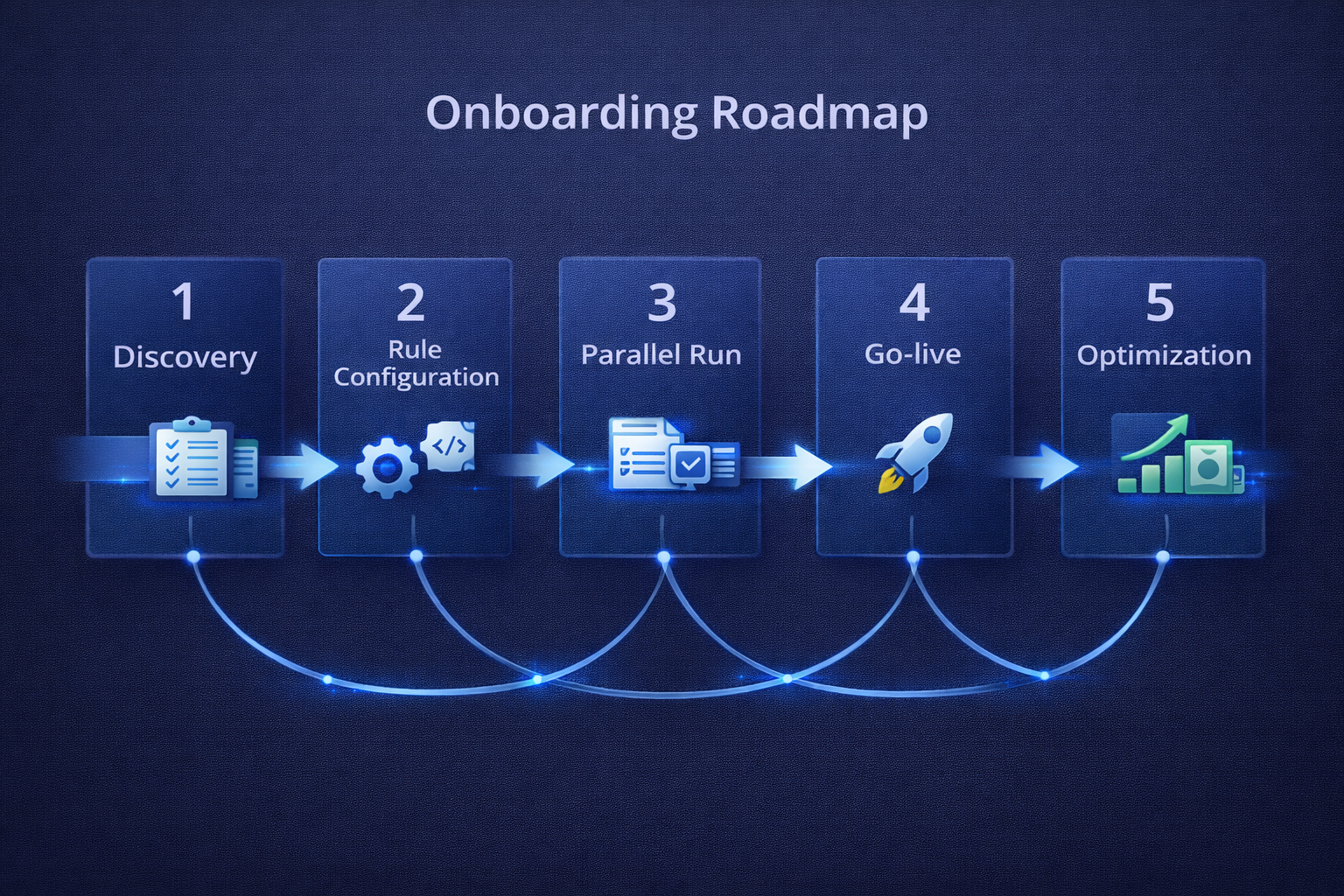
A structured approach ensures smooth onboarding and fast results:
1. Discovery & Assessment
Review current denials, workflows, payer mix, test catalog, and LIS connections to identify opportunities.
2. Tailored Rule & Workflow Design
Build payer-specific edits, coding logic, and AR strategies.
3. Parallel Run / Pilot Phase
Run tailored billing alongside the existing billing process to benchmark performance.
4. Full Transition
Move into production with real-time monitoring and continuous optimization.
5. Ongoing Improvements
Monthly reporting, payer rule updates, denial trend reviews, and workflow refinements help sustain long-term revenue growth.
Key KPIs That Demonstrate the Impact of Tailored RCM
Impact Innovations tracks KPIs that matter most for labs:
First-pass acceptance rate
Overall denial rate
Days in AR
Net collection rate
Cost-to-collect
Appeal turnaround time
Underpayment recoupment
AR aging over 90 days
A consistent improvement across these metrics directly reflects stronger financial health.
Conclusion: Tailored Billing Isn’t Optional — It’s the New Standard for Lab Revenue Growth
As diagnostics and clinical testing evolve, payer scrutiny increases and margins tighten. Laboratories cannot afford generic billing strategies or outdated RCM practices. Tailored billing lifts revenue, reduces waste, and strengthens financial predictability — and for many labs, outsourcing RCM to a specialized partner is the most effective way to achieve these improvements quickly.
Impact Innovations combines deep laboratory expertise with advanced billing workflows, payer-specific intelligence, and transparent reporting — giving labs a revenue engine designed specifically for them.
FAQs
Q1: What is tailored billing for labs?
A: Tailored billing customizes claim creation, payer edits, coding, and AR workflows to a lab’s test catalog, LIS setup, and payer mix — increasing first-pass acceptance and revenue.
Q2: How much can labs improve revenue with tailored billing?
A: Improvements vary by baseline performance; typical outcomes include reduced denials, increased net collection rate, and shorter Days in AR. Many labs see measurable improvements within 60–120 days of implementation.
Q3: When should a lab outsource RCM?
A: Consider outsourcing when denials persist, internal billing is understaffed, AR days are high, or you need faster access to automation and payer expertise.
Q4: Is outsourcing RCM safe for PHI?
A: Yes — with a signed BAA, SOC2/ISO compliance, secure data transmission, and role-based access controls, outsourced RCM can meet strict PHI security standards.
